Ride the Hemlock chairlift at Boyne Mountain on a July afternoon and you will be sitting in the same seat skiers fight over in February. Down below there are no moguls, just fairways. At the top you can walk SkyBridge Michigan, the world’s longest timber-towered suspension bridge, 118 feet above the valley. And if you squint toward the bottom of the hill, you are looking at the spot where northern Michigan golf got started.
Here is the part most golfers never think about. A lot of the best golf in America’s Summer Golf Capital was never supposed to exist. Four of the group’s eight resorts started as ski hills that needed a reason to keep the lights on in July: Boyne Mountain, The Highlands, Crystal Mountain, and Treetops. Golf was the summer side hustle. Seventy-some years later, the side hustle is the reason people book the trip.
A Dollar, a Tractor, and a Very Good Idea
The story starts with Everett Kircher, a Detroit Studebaker salesman who loved skiing but hated driving halfway across the country to do it. In 1947, a Michigan state senator sold him a hilly parcel near Boyne Falls for one dollar, reportedly figuring anyone crazy enough to build a ski resort up there deserved the help. The next year, Kircher found out Sun Valley was selling off its original chairlift. He bought it and hauled it to Michigan. Legend has it he had once ridden that lift right behind a whistling Bing Crosby, which is the best provenance story any chairlift has ever had.
Skiing paid the bills in winter. Summer was a problem. Kircher did not want to lay off his staff every spring, so in the early 1950s he built a nine-hole par-3 course called the Hemlock, and he built it himself with his father’s Ford farm tractor. No architect, no routing plan, no consultants. Just a guy, a tractor, and a hill he already owned.
That little course was the seed. When Kircher bought the Harbor Highlands Ski Area outside Harbor Springs and turned it into Boyne Highlands in the early 1960s, he started getting serious about golf. He talked Robert Trent Jones Sr., the most famous architect in the game at the time, into designing The Heather, which opened in 1966. Then the ski business ran into a wall. Cheap airfare was sending Midwestern skiers to the Rockies, so Kircher doubled down on golf. The Alpine opened at Boyne Mountain in 1970, the Moor followed at the Highlands, and The Monument came along in 1985. The ski company had quietly become a golf company.
The Hemlock is gone, but the name lives on as the chairlift that carries you up to SkyBridge. That is the kind of detail you cannot make up.
The School Project That Became a Resort
Crystal Mountain’s origin story is even better. It began as a class assignment. A geography teacher at Benzonia High School asked his students to find the best place in Benzie County to start a ski area. Locals picked a spot for its elevation and snowfall, and in 1956 the Buck Hills Ski Area opened. It had a rope tow powered by an old pickup truck engine and a warming hut built from donated lumber. The original runs were named Buck, Doe, and Fawn, and Buck is still one of the most challenging slopes on the mountain.
In 1981, sole ownership came down to a coin toss between George Petritz and his partner Robert Meyer. Petritz won. The family has run the place ever since, and that is how a resort that started with a truck engine ended up with two of the best courses in the state. Betsie Valley opened in 1977, and next year marks 50 years of golf at Crystal. Mountain Ridge followed in 1995 and was named the 2025 Michigan Golf Course of the Year.
The Old Ski Hill Outside Gaylord
Treetops started in 1954 as the Sylvan Knob Ski Area, a modest hill with two rope tows and six slopes. In 1983, auto parts executive and NASCAR team owner Harry Melling bought it, and he did not stop at skiing. He brought in Robert Trent Jones Sr. Jones looked out over the endless canopy of the Pigeon River valley and suggested a new name. Sylvan Knob became Treetops.
The Masterpiece opened in 1987 as one of the final designs of Jones’s career. Melling then hired a little-known Ohio golf pro named Rick Smith to run the golf program and eventually gave him his start as an architect. Smith designed The Signature, The Tradition, and Threetops, the par-3 course that hosted the ESPN Par-3 Shootout. Melling also brought in Tom Fazio for The Premier. A sleepy ski hill turned into 81 holes and one of the most recognizable golf resort names in the Midwest.
Why Ski Terrain Makes Better Golf
This is where the history turns into something you will feel in your legs. The Midwest is not known for elevation, but these courses were routed on and around ski terrain, and they play like it.
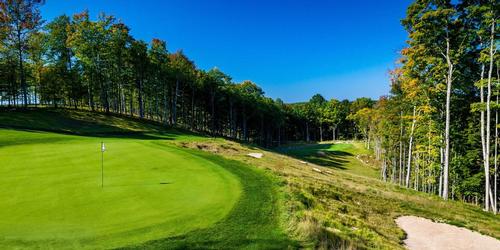
On the Arthur Hills course at The Highlands, you hit the 13th tee shot from the top of a ski slope. On The Monument at Boyne Mountain, you ride more than a mile up the mountain before your first tee shot. At Crystal Mountain, Mountain Ridge carves through forested highlands with 200-foot elevation swings, and its closing stretch climbs the ski hill before finishing with a downhill par 5 you can reach in two. The Masterpiece at Treetops is all big drops and long views across the treetops it was named for.
You can’t fake that kind of terrain with a bulldozer, and the ski founders didn’t have to. They just put golf holes on hills they already owned.
The Rest of the Lineup
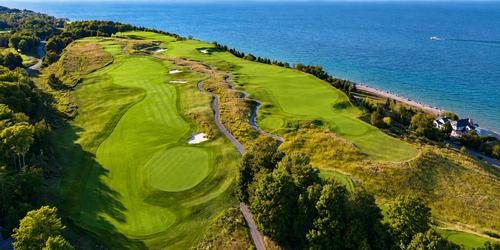
The four former ski hills are only half the story. Boyne added Bay Harbor in the 1990s, building the Links, Quarry, and Preserve nines along Lake Michigan, plus Crooked Tree up the hill. Grand Traverse Resort brings Jack Nicklaus’s The Bear and Gary Player’s The Wolverine. Garland Lodge and A-Ga-Ming round out the group. But the ski hills built the foundation, and you can still see it in the routing.
The Four-Season Trip Nobody Else Can Sell
Here is the payoff for buddy trips and couples alike. Pinehurst can’t sell you a ski weekend, and neither can Scottsdale. Up here the same resort, sometimes the same lodge room, works in January and July. Plenty of groups that ski Boyne or Crystal in the winter come back in summer with golf clubs, and the reverse happens too.
Even in the dead of summer, the lifts earn their keep. You can ride up for SkyBridge views, grab a drink at Eagle’s Nest at the summit at Boyne Mountain, and check out the mountain biking and hiking on the old ski runs. If the rain rolls in, Avalanche Bay, Michigan’s largest indoor waterpark, is waiting.
Bottom Line
Everett Kircher built a golf course because he didn’t want to lay anyone off in the summer. A high school geography class picked the hill for Crystal Mountain. Harry Melling bought a sleepy ski area and handed the shovel to Robert Trent Jones Sr. None of them set out to build America’s Summer Golf Capital. They were just trying to fill the months when there was no snow.
It worked better than any of them could have imagined. The next time you are standing on an elevated tee in northern Michigan, looking down at a fairway that drops a couple hundred feet, take a second to look around. There is a good chance you are standing on a ski run.
Northern Michigan's appeal goes beyond its remarkable golf history. Discover how the region's extended summer daylight makes it a golfer's paradise in our article, Is Northern Michigan Really America's Summer Golf Capital? Check the Sunset.